In times like these, holding a large Portfolio of stocks can be nerve-wracking. The markets for equity have been making new all-time highs but the rationale for these elevated price levels is a bit shaky.
Older people who managed their the money they earned during Black Monday (1987) and the Dot-com bubble (1995-2000) warn about the possibility for similar events today at the same time that Wall Street encourages retail investors to take on even greater risk.
Headline investors like Ray Dalio and Mark Mobius have publicly stated that investors must have 5 to 10 percent of their investment funds held in physical Gold. In the Ray Dalio All Weather Portfolio, as an example, contains the 7.5 percent allocation to gold.
The highly successful investors are suggesting physical Gold as a way to protect themselves against the stock market , while noting the possibility of currency devaluations in the aftermath of massive pandemic-related fiscal and monetary stimulus.
In this article, we'll look at different strategies for the protection of an investment portfolio against stock market and Inflation risk.
How to evade versus Inflation
There are several assets that are commonly considered inflation hedges:
Precious metals (Silver particularly)
Commodities
Real estate investment trusts (REIT)
Treasury Inflation Protected Securities (TIPS)
As with all possible Investments, each of these asset classes has pluses and minuses that an investor must consider.
Precious metals
The purchase and keeping of physical Gold and Silver is a time-tested strategy for hedging against Inflation. Precious metals can also be a good option to diversify an Investment portfolio and hedge against stock market risk.
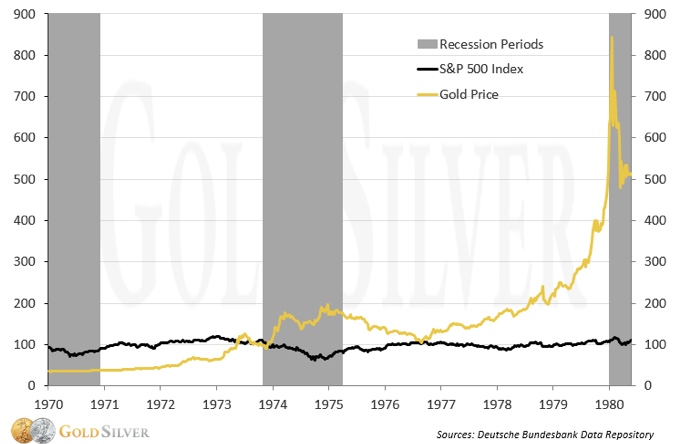
During the Great Inflation of the 1970s (1963 to 1980) Gold rose by 1600 per cent and Silver rose 2700%. Investors with foresight could purchase Silver for $1.29 and the Gold for $35 an ounce in 1963. In 1980 , the smart investors could take profits on their Investments at $50 and $800 per an ounce.
The most effective way to invest into Silver and Gold is to get personal ownership of these Precious metals and keep them in a local storage facility.
There is also the possibility to gain exposure to the metals through ETFs and Gold Trusts (e.g. GLD, GLD) as well as SLV Trusts, Silver Trusts (e.g. SLV) and certificates program (e.g., Perth Mint).
Investors who have retirement savings that are tax-deductible can purchase physical Precious metals with those funds through the creation of an auto-directed Gold IRA. Both tax-exempt and tax-deferred Retirement accounts are able to be transferred into Gold IRAs.
Commodities
Commodities are real assets such as orange juice or steel rolled. During inflationary times prices on real goods tend to increase.
From an Investment standpoint, There are two types of commodities that you should keep in mind: hard and soft.
Hard commodities must be mined or dug and this is the case for precious metals such as aluminum, copper crude oil, natural gas and more.
Soft commodities can be found in the ground or are walked over it on four hooves. Wheat, corn live hogs, corn, and feeder cattle are examples of soft commodities.
ETFs allow investors for investors to put money into both hard and soft commodities.
Commodity futures are not recommended because of the assignment risk. Options on commodity futures are a possible stock market hedge but these securities represent a high level of risk.
Real estate investment trust (REIT)
REITs are investment vehicles that hold funds of income-generating Real Estate. Inflation is a force that pushes both rental rates and property prices higher.
Investors buy individual shares of a REIT to get exposure the Real Estate without taking on the burden of finding or financing the properties the properties.
Residential REITs are specialized in apartments, single-family houses, mobile homes, and student housing. Commercial REITs are focused on retail stores, office buildings hotels, as well as other forms of commercial properties that earn income.
A small portion of REITs concentrate on the holding of mortgage debt (Mortgage REIT) while most REITs focus on holding income-generating properties (Equity REIT).
Treasury Inflation Protected Securities (TIPS)
TIPS which is also known as Treasury Inflation Protected Securities, offer the security of a Treasury bond with the assurance that the buyer will get at the very least their initial Investment back.
The principal value of a TIPS bond is adjusted to reflect that of the CPI (Consumer Price Index) over the duration of the bonds. Annual coupon payments are based on the principal amount of the bond, so the investor receives an inflation-adjusted amount from their TIPS.
For an example, think of an investor who owns $5,000 worth of TIPS with a 5-year term paying a 1% coupon rate. If the rate of inflation (as measured using CPI) is 4%, then the bond's value CPI) is 4.4% The $15,000 worth of bonds will be adjusted to $15,600. The bond's coupon payment is then calculated on the adjusted value of the principal so the investor receives $156 interest for the entire year.
Notice that the investor's original Investment (the principal of the bond) is adjusted to reflect inflation in this case, but the investor is locked in a 1% interest rate vehicle in an environment in which higher coupon rates are likely to be available.
For those who are wary of risk, the lower return from TIPS might be acceptable for the perceived safety of the US Treasury bond.
Specifically how to circumvent against rising prices
We have to be careful when we start talking about the best of anything in the investing world. The best hedge against Inflation is likely to be different for a 25-year old than for a 65-year old.
An investor's tolerance for risk also affects what their ideal Inflation hedge will look like. A risk-averse investor may avoid commodities because of volatility while the risk-tolerant investor loads up on physical Silver and shares of energy ETFs.
Why is Gold a skirt versus rising cost of living
Gold is perceived as a hedge against Inflation due to the fact that the cost of Gold tends to increase as the purchasing power of the currency in which the metal is priced diminishes.
The cost of the gentleman’s suit is used as the classic example of Gold acting as an insurance against Inflation.
In 1922, a tailor-made wool suit (a tailor-made suit) and an extra pair of pants cost around $25 US Dollars, and Gold was sold at $20.67 per an ounce.
Fast-forward to today and an equivalent manaEUR(tm)s suit costs $1500 to $2000 with Gold being sold for about $1800 an ounce.
That's 100 years where one ounce of Gold has protected its owner from the devastation of Inflation.
Just how to purchase Gold
There are a number of ways for you to make an investment in Gold. As already stated the best Gold Investment involves purchasing the physical metal and then storing it somewhere that you have the ability to access it.
Once the foundation has been laid, there are numerous ways to invest in Gold:
Physical Gold Trusts and ETFs (e.g., Sprott Physical Gold Trust PHYS, or GLD)
Mining stock, warrants and options
Self-directed Precious metals Irrevocable savings accounts (Gold IRAs)
Gold futures
The options available on Gold futures
Physical Gold Trust
These Physical Gold Trusts such as GLD (SPDR Gold Shares Trust) are fraudulent as they provide investors with the illusion of owning physical Gold however all the owner actually has is shares of a security that is (supposedly) connected in some way to physical Gold.
It is crucial to understand that these Gold Trusts are not securities, but Gold itself. These are physical derivatives Gold but they do not provide an buyer any ownership interest in the actual metal.
Shares of the Gold Trusts are supposedly redeemable for physical metal, however only investors who have a solid financial foundation are in a position to do this.
The Sprott Physical Gold Trust (PHYS) requires that investors redeem their shares in 400oz increments. With Gold around $1780 an ounce that means an investor will require seventy-one thousand dollars of PHYS to ensure it is possible to take delivery of actual metal.
GLD which is the SPDR Gold Shares Trust, has an even more stringent threshold for the delivery of physical Gold.
Investors who have been approved to redeem 100,000 shares of GLD at a time and request the delivery of physical Gold. at today’s rate (01/07/2022) this amounts to an investment of around $16.8 million US dollars.
Self-directed Precious metals IRA
Precious metals IRAs provide investors with a means to build an Gold stock market hedge using Tax-deferred Retirement funds.
Unless an investor is willing to pay the penalty of 10% for premature withdrawals of their tax-deferred , tax-exempt funds (401K, 403b or traditional IRA or traditional IRA, etc. ) The money is effectively locked up in some form of IRS-approved investment vehicle up to the age of 59 and 1/2 .
Gold IRAs are in this category of approved investments and allow investors to gain the security and protection of physical Gold ownership without having to pay any tax or penalties in the process.
Final thoughts
In this short piece, we've focused on using Gold to protect against stock market risks caused by inflation.
Stock Portfolios are exposed to a variety of other risks, including Inflation. There is the risk of equity as https://sites.google.com/view/registeredinvestmentadvisor/gold well as liquidity risk and currency risk that investors have to be aware of and, potentially, to hedge against.
Luckily, Gold is able to protect against these risks too. Portfolio research shows that a small portion of Gold can boost the overall performance of the stock Portfolio and reduce drawdowns. Ray Dalio's All Weather Portfolio demonstrates this with its 7.5% allotment to gold.
For more information about Precious metals and hedging, visit this site. Satori Traders website and Satori Traders YouTube channel.
Bryan V Post is the founder and CEO of Satori Traders LLC, a California-registered Investment Advisor (RIA).
Mr. Post is a California-registered Investment Advisor Representative specializing in the Precious metals.
5 ‘Strong Buy’ Gold Stocks to Power Up your Portfolio
With inflation rising, investors are looking for a safe place to park their money. According to the Consumer Price Index (CPI) from November, inflation of 6.8% was the highest in 39 years. Fannie Mae, the government-backed mortgage supporter, projects inflation to grow to an average of 7% in the first quarter of 2022, before falling to 3.8% by the end of the year.
Gold has long been considered the gold standard for an inflation-hedging investment. Instead of purchasing physical gold, investors can find the top gold stocks to invest in.
Using TipRanks' stock screener, I have identified 5 gold stocks with a Strong Buy consensus rating from analysts. While they might not prove to be gold mines for investors, all of these stocks could prove to be a good choice for safe sailing through the inflation ahead.
https://www.nasdaq.com/articles/5-strong-buy-gold-stocks-to-power-up-your-portfolio